Seasonal··6 min read
When & Where to See Provence's Lavender Fields
JM
Jean-Pierre Moreau
Luxury Travel Director
The complete timing guide for Provence's lavender season: best fields for photography, peak bloom dates by altitude, driving routes, and luxury dining recommendations nearby.
When to Visit: Peak Lavender Season
The lavender fields of Provence are one of the most iconic images of France. But timing is everything — the season is short, and the exact dates depend on altitude, variety, and weather.
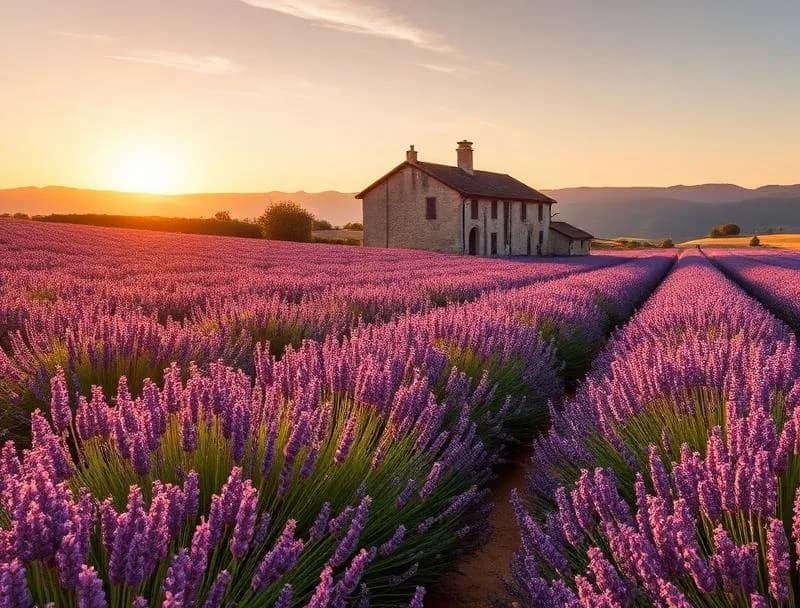
Peak season is typically mid-June to mid-July at lower altitudes (Luberon, Drôme Provençale), and late June to early August at higher altitudes (Plateau de Valensole, Sault). The harvest usually begins in mid-July.
Senanque Abbey: The Most Photographed Field
Sénanque Abbey, near Gordes, is the most photographed lavender field in the world. The rows of purple against the 12th-century Cistercian abbey create an unforgettable image. Arrive before 9 AM for photography without crowds.
A note on Sénanque: the abbey is still an active monastery, home to a small community of Cistercian monks. Visits to the interior are by guided tour only and require silence in certain areas. The lavender field itself is accessible from the road above, and the best photographic angle is from the hillside looking down toward the abbey entrance.
Plateau de Valensole: Endless Purple Rows
The Plateau de Valensole offers the most expansive fields — endless rows stretching to the horizon. This is where most of the 'Provence lavender' images you've seen were actually taken.
Valensole is also the center of Provence's almond cultivation, and in spring the fields bloom white before turning purple. The contrast between the red earth, green oaks, and purple lavender under the Provençal sun is extraordinary. Several farms on the plateau welcome visitors for distillery tours where you can see the extraction process and purchase essential oils directly.
The Sault Festival and Photography Tips
The town of Sault hosts a lavender festival on August 15 each year, marking the end of the season. It's a wonderful culmination of the lavender experience, with markets, distillation demonstrations, and local festivities.
Photography guidance: early morning (6 to 8 AM) and golden hour (7 to 9 PM in high summer) produce the most dramatic images. Midday light flattens the purple into monotone. A low angle, shooting along the rows rather than across them, creates depth. A single figure — walking, cycling, or standing — provides scale that transforms a landscape shot into a story.
Beyond Lavender: Villages, Markets, and Dining
Beyond lavender, the same trip can encompass the ochre villages of Roussillon and Rustrel, the antique markets of L'Isle-sur-la-Sorgue (Sundays are best), and the dramatically perched hilltop villages of Gordes, Bonnieux, and Ménerbes. The Luberon is compact enough to explore four or five villages in a day.
Dining in Provence during lavender season is exceptional. The region's produce is at its peak — tomatoes, courgettes, peaches, melons — and chefs throughout the Luberon incorporate lavender into both savory and sweet dishes. At La Bastide de Capelongue in Bonnieux, chef Edouard Loubet has earned two Michelin stars for cuisine rooted entirely in the surrounding landscape.
Driving Considerations and Practical Advice
A practical consideration: the D-roads connecting lavender fields and hilltop villages are narrow, winding, and busy during peak season. Having someone else at the wheel allows you to absorb the scenery rather than navigate blind curves. The roads between Gordes and Roussillon, in particular, demand full attention.
Ready to Experience This?
Let our private chauffeur service transform your French journey. English-speaking drivers, Mercedes S-Class, door-to-door luxury.
Book Your Chauffeur